Medical Ultrasound Imaging
Sunday, 20 September 2026

 Info Sheets  Out- side     | 'SD' p18 Searchterm 'SD' found in 199 articles 26 terms [ • ] - 173 definitions [• ] Result Pages : •
2D ultrasound imaging is a widely used technique in medical imaging that provides two-dimensional visual representations of internal structures. A handheld device known as a probe or transducer contains piezoelectric crystals that emit and receive ultrasound waves which penetrate tissues and bounce back as echoes. The echoes are detected and converted into electrical signals. These signals are processed and displayed on a monitor, creating a real-time 2D grayscale image, with different shades of gray representing various tissue densities. The brighter areas on the image correspond to structures that reflect more ultrasound waves, while darker areas represent structures that reflect fewer waves or are attenuated by intervening tissues. The 2D-mode (or B-mode) provides cross-sectional views of the scanned area, showing a single plane or slice of the scanned area at a time. Key Features and Uses of 2D Ultrasound: •
•
2D ultrasound is excellent for visualizing anatomical structures and detecting anomalies. It is widely used in obstetrics, gynecology, abdominal imaging and vascular examinations.
•
Due to its real-time capabilities, 2D ultrasound is utilized to guide various procedures, including biopsies, injections, and catheter insertions.
•
2D sonography can incorporate Doppler technology to assess blood flow in vessels, aiding in the diagnosis of vascular conditions and evaluating fetal circulation.
Comparison with 3D and 4D Ultrasound: •
Unlike 2D ultrasound, which generates a series of 2D images, 3D ultrasound creates a three-dimensional volume of the scanned area. This allows for more detailed visualization of complex structures, such as fetal facial features or organ morphology.
•
4D ultrasound adds the dimension of time to 3D imaging, resulting in dynamic three-dimensional videos. It enables the visualization of fetal movements and provides a more immersive experience. However, a 4D sonogram is not typically used for diagnostic purposes and is often employed in baby ultrasound examinations for bonding and enjoyment purposes.
See also Ultrasound Technology, Sonographer, Ultrasound Elastography, Obstetric and Gynecologic Ultrasound. • 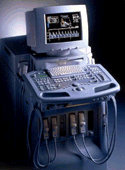 From Siemens Medical Systems;
The ACUSON Aspen™ ultrasound system resulted from a unique convergence of select ACUSON Sequoia™ ultrasound system technologies and other ACUSON innovations to form an entirely new imaging platform. Its new digital system architecture provides complete digital control of the ultrasound echoes from the transducer through the captured digital examination. Specifications for this system will be available soon. • 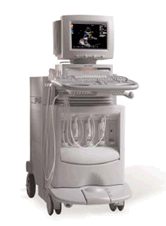 From Siemens Medical Systems;
'Conventional ultrasound systems are unable to compensate for the unique acoustic signature of individual patients. But there is nothing conventional about the new ACUSON Sequoia™ C512 echocardiography system with Sequoia™ matched response technology.'
Device Information and Specification
APPLICATIONS
CONFIGURATION
Compact, portable
2D-Mode, M-mode, Cadence™, Native® Tissue Harmonic Imaging, Transmit Compounding, SST™ Color and Solo™ Spectral Doppler
STORAGE, CONNECTIVITY, OS
KinetDx integrated PACS, DIMAQ-Workstation
• 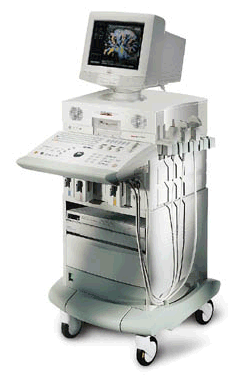 From ESAOTE S.p.A.;
'The AU5 EPI is an ultrasound system for multi-disciplinary use that incorporates all the transducer technologies (linear, convex, phased array, and annular array) adapted to today's most diverse diagnostic requirements. Furthermore it offers the most modern and advanced techniques available today on the market.' •  [This entry is marked for removal.]
'Acusphere (NASDAQ:ACUS) was a specialty pharmaceutical company that develops new drugs and improved formulations of existing drugs using its proprietary microparticle technology. Acusphere's three initial product candidates are designed to address large unmet clinical needs within cardiology, oncology and asthma. These product candidates were created using proprietary technology that enables Acusphere to control the porosity and size of nanoparticles and microparticles in a versatile manner that allows particles to be customized to address the delivery needs of a variety of drugs. Acusphere's lead product candidate, AI-700 (new trade name Imagify™), is a cardiovascular drug in Phase 3 clinical development. AI-700 is designed to enable ultrasound to compete more effectively with nuclear stress testing, the leading procedure for detecting coronary heart disease. An estimated 9.5 million procedures are done each year in the U.S. to detect coronary heart disease, the leading cause of death in the United States.' In 2008 the FDA panel rejected the regulatory application for AI-700 (Imagify™) because of safety concerns. Result Pages : | Share This Page     Look Ups |
Medical-Ultrasound-Imaging.com
former US-TIP.com
Member of SoftWays' Medical Imaging Group - MR-TIP • Radiology TIP • Medical-Ultrasound-Imaging
Copyright © 2008 - 2025 SoftWays. All rights reserved.
Terms of Use | Privacy Policy | Advertise With Us
former US-TIP.com
Member of SoftWays' Medical Imaging Group - MR-TIP • Radiology TIP • Medical-Ultrasound-Imaging
Copyright © 2008 - 2025 SoftWays. All rights reserved.
Terms of Use | Privacy Policy | Advertise With Us
[last update: 2025-04-05 02:38:00]